Matlo
ENFRCreate an accountSign up
Chess profile

Your chess level, area by area, compared with players at your level

Matlo's profile gives a rating to every area of your play, opening, middlegame, endgame, tactics, time management, compared with Lichess players at your exact rating and with you a few months ago. It only names a strength or a weakness when the gap is likely and large enough.

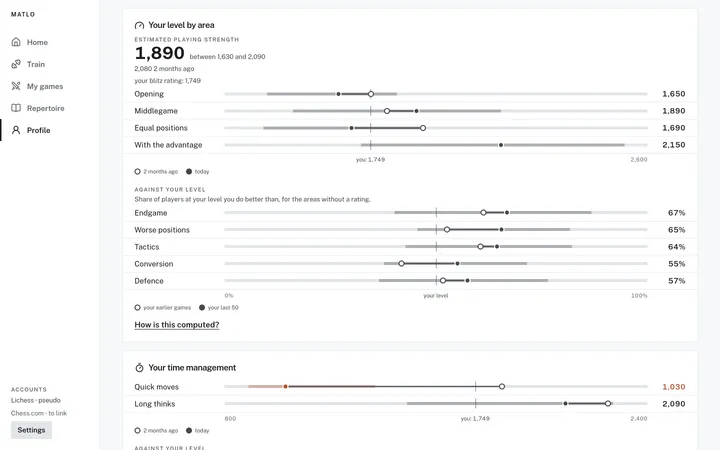
Profile: estimated playing strength and a rating for each area against players at the same level
19measures compared with players at your level
10areas with their own rating
25rating points between two references
95%first motifs right, on 400 puzzles

What costs you points

Every mistake and blunder in your analysed games gets its tactical motif: hanging piece, fork, pin, mate… The profile tells you your number one motif and how often it happens, for instance “every 4 games”, with the last position where it cost you, and leads to a puzzle series on that motif.

Motifs come from the Lichess theme classifier, applied to the engine lines: the best move you did not play, or the opponent's best reply after your move. On 400 Lichess puzzles, the first motif found this way is the right one 95% of the time.
A rating for every area

A number alone says nothing: is losing 3% winning chances per endgame move a lot or a little? Matlo measures the same 19 things on the evaluated games in the public Lichess files, about 6.7 million games a month, and finds the rating of players who do as well as you: your endgame “plays like a 1900”. The band around the rating is its range; it narrows with the number of games.

Ten areas get a rating this way, those where stronger players really do better. The others, like conversion or defence, where everyone faces their own level, read as the share of players at your level you do better than. The hollow dot is your measure a few months ago, on different games from today's.

  • Estimated playing strength, all phases together
  • Opening, middlegame, endgame; equal positions or with the advantage
  • Tactics: opponent mistakes punished
  • Conversion, defence, worse positions, against your level

Your time management

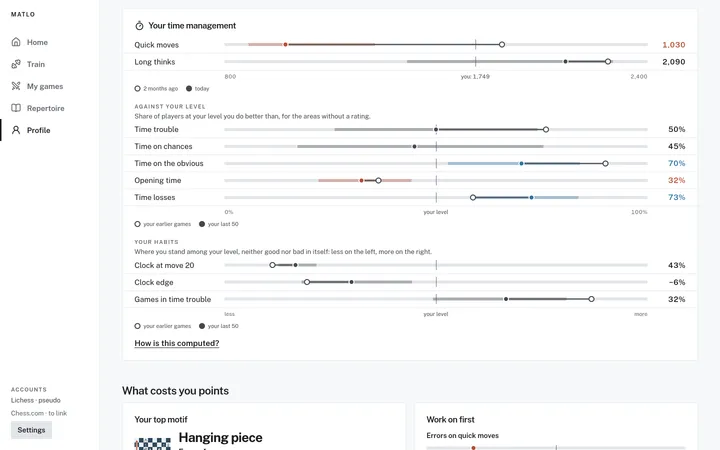
The clocks of your games show how you spend your time, compared with players at your level. Mistakes on quick moves, on long thinks and in time trouble, and time taken right after your opponent errs: among Lichess players, stronger ones take clearly more time when the chance comes, so these areas have a rating.

Time spent on obvious moves and on the first 10 moves is compared with your level. Clock at move 20, clock edge over your opponent and games in time trouble are benchmarks with no good or bad direction: strong players even get into time trouble more often.

Your time management: errors by time taken, time on chances, clock at move 20

A careful verdict, a concrete action

Chance weighs heavily over 50 games. Your rate is therefore pulled towards your level's average according to how many situations you played, and a dimension is never judged below a threshold: 15 winning positions, for instance, for conversion. A strength or weakness is only named when it is 90% likely and large enough; otherwise the profile says “about average for your level”.

Every area to work on leads to something to do: the series of your number one motif for tactics, wasted advantages for conversion, the positions from your games where the area came into play for the others. You can also make it your focus for three weeks: its exercises join your daily plan, and its rating on your next games tells whether you improved.

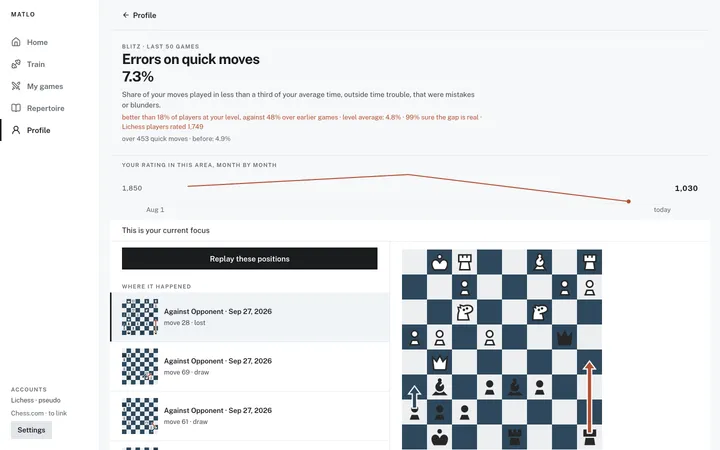
A dimension page: mistakes on quick moves, comparison with your level and the positions where it happened

Your openings and your progress

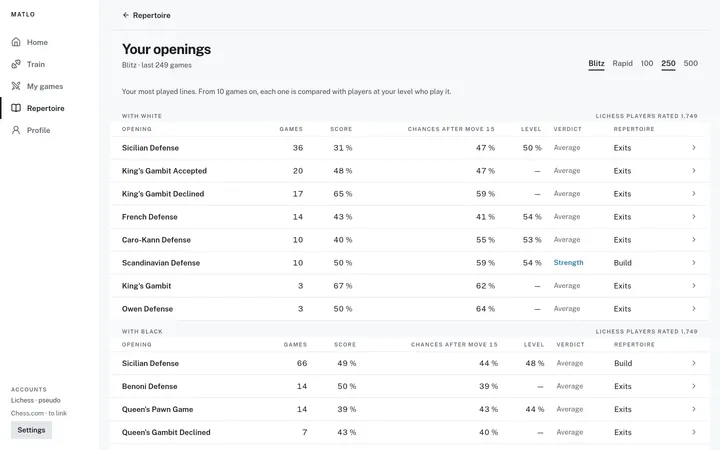
Your openings are named after the Lichess list, transpositions included, and every line played at least 10 times is compared with players at your level: your winning chances after move 15 and the accuracy of your opening moves.

Progress shows what changes over a period: puzzle rating, mistakes per game week after week, motifs per 10 games, regularity, and the period against the previous one. You see whether the training works.

Your openings: lines played with White and Black, chances after 15 moves compared with your level

Numbers you can check

Every dimension opens the list of moves where it came into play in your games: mistakes on quick moves, winning positions you did not convert, opponent mistakes you did not punish. You see the position, the move played and the best move, and you open the game at that point.

The ten most recent positions of a dimension can then be replayed as an exercise: the position before your move, to find better, without your rating moving.

Frequently asked

Where do the players at my level come from?

From the public files of database.lichess.org: every month, the blitz, rapid and classical games evaluated by Lichess are measured like yours, in 25-point rating steps.

I mostly play on Chess.com, does the comparison work?

Yes. Your Chess.com rating is converted into its Lichess equivalent per time control, with a public conversion table between the two scales.

How many games does it take?

Your mistake profile starts at 10 analysed games. The comparison with your level reads your last 50 games of a time control and only judges a dimension above a minimum number of situations.

Why “about average” for most dimensions?

Because it is often true, and naming a false weakness would have you work on the wrong thing. Matlo only keeps gaps that are likely and large enough.

Start with your last 20 games

Link Lichess or Chess.com: your games are analysed within minutes, then your first puzzle is waiting.

Create an account