Matlo
ENFRCreate an accountSign up
Visualization

Chess visualization: blindfold, hidden moves, warm-ups

Visualization is the ability to see the position without looking at it: remembering the pieces, following a line in your head, knowing what a piece attacks. Matlo trains it with three separate exercises, each with its own level, gathered in the Visualization section of the Train space.

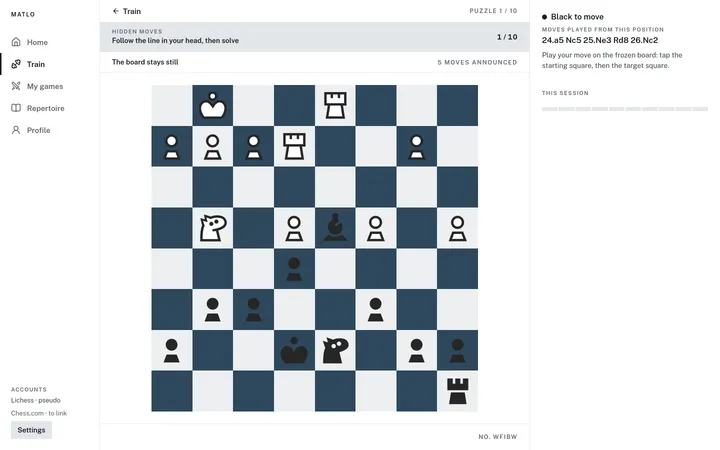
Hidden moves: the moves played from the position are written, the board does not move
10 sto memorise the blindfold position
3 to 13plies announced in hidden moves
30 sper warm-up, 3 s off per mistake
2separate ratings: blindfold and hidden moves

Blindfold

The position stays visible for 10 seconds, long enough to memorise it, then the board empties. You solve the puzzle from memory, with no time limit; the opponent's reply is written and its squares marked.

Difficulty is the number of pieces, not speed. Your level reads in pieces, for instance “level 10 pieces”, and rises as you succeed. Puzzles are short and easy for your rating: your memory does the work, not your calculation.
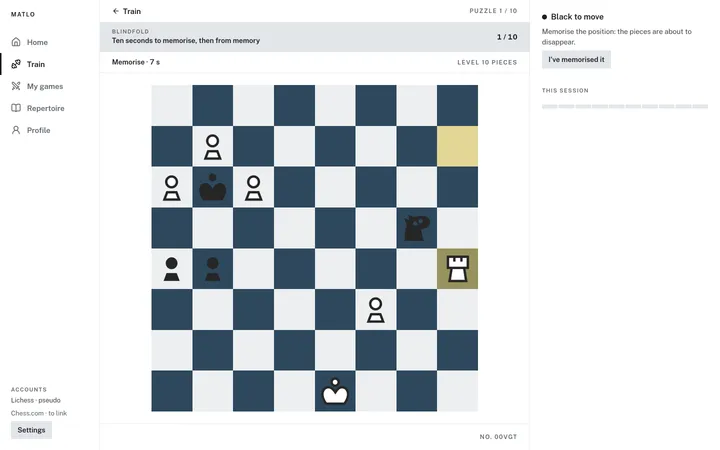
Blindfold: the position to memorise before the board empties

Hidden moves

A position, then the moves that follow it, written without being played: you follow them in your head, then solve on the board, which stays frozen. The last written move is your opponent's, and you must find the reply.

The number of announced moves grows with your rating, from 3 to 13 plies. Positions come from your games, with your real moves before the mistake, or from Lichess puzzles whose leading moves were recovered from the original games.

30-second warm-ups

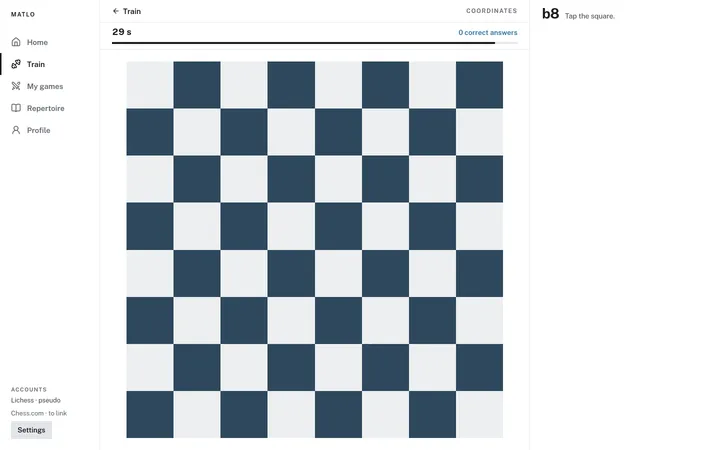
Four short exercises to see the board: find a square from its coordinates on a board with no letters or numbers, tell the colour of a square, count a knight's moves from one square to another, tell whether a piece attacks a square.

Each lasts 30 seconds, a mistake takes 3 off, and your record is kept. The hidden position goes further: you look at a real position, then answer questions about it without seeing it.

  • Coordinates
  • Square colours
  • Knight paths
  • Attacked squares
Coordinates warm-up: a board with no markings and a square to touch

Hidden position

A real position from the database, from 6 to 20 pieces, which you look at for as long as you like. Then it disappears and three questions arrive: where is a given piece, which piece is on a given square, how many moves give check, which piece is undefended.

You can keep one disc per piece, without its type, to help you at first, then do without. The summary circles the answer squares on the position: you see what your memory kept and what it lost.

A separate level for each exercise

Memorising a position and calculating a line are skills distinct from solving a puzzle on the clock. Mixing their results into a single rating would say nothing. Blindfold and hidden moves therefore each have their own Glicko-2 rating, with the puzzle as the reference opponent, and their attempts count neither towards your puzzle rating nor towards puzzles to redo.

The level reads in the exercise's own unit: a number of pieces for blindfold, a number of announced plies for hidden moves. You know what you can hold in your head.

Frequently asked

What is visualization for?

Calculating further: a four-move line requires seeing the position after each of them without playing it. The exercises isolate that skill.

Do visualization exercises change my puzzle rating?

No. Blindfold and hidden moves each have their own rating, and warm-ups their record.

I am new to visualization, where should I start?

With the warm-ups, then blindfold with few pieces: the level adapts to your results.

How long does it take to improve?

Visualization exercises are short: a warm-up lasts 30 seconds, a hidden position three questions. A few minutes a day, on top of your puzzles, are enough to see your level in pieces rise.

Start with your last 20 games

Link Lichess or Chess.com: your games are analysed within minutes, then your first puzzle is waiting.

Create an account